 Skip to content

The safest way to dispose of medicines found during a house clearance is to return them to a community pharmacy. Keep them separate from ordinary clearance waste, and leave tablets in their original packaging.
You may be sorting a relative’s belongings, managing an estate or preparing an empty property. You don’t need to identify every medicine yourself, but safe separation matters before anything is removed.
Start by securing what you’ve found, then arrange the right disposal route.
Key takeaways
- Return unwanted household medicines to a community pharmacy, including expired medicines and most over-the-counter products.
- Keep medicines out of household bins, skips, sinks and toilets. Never use them, donate them or pass them to someone else.
- Separate needles and other clinical waste. Tell the clearance provider about medicines and these clinical items before work begins.
1. Make medicines safe before sorting
Leave medicines in their packaging
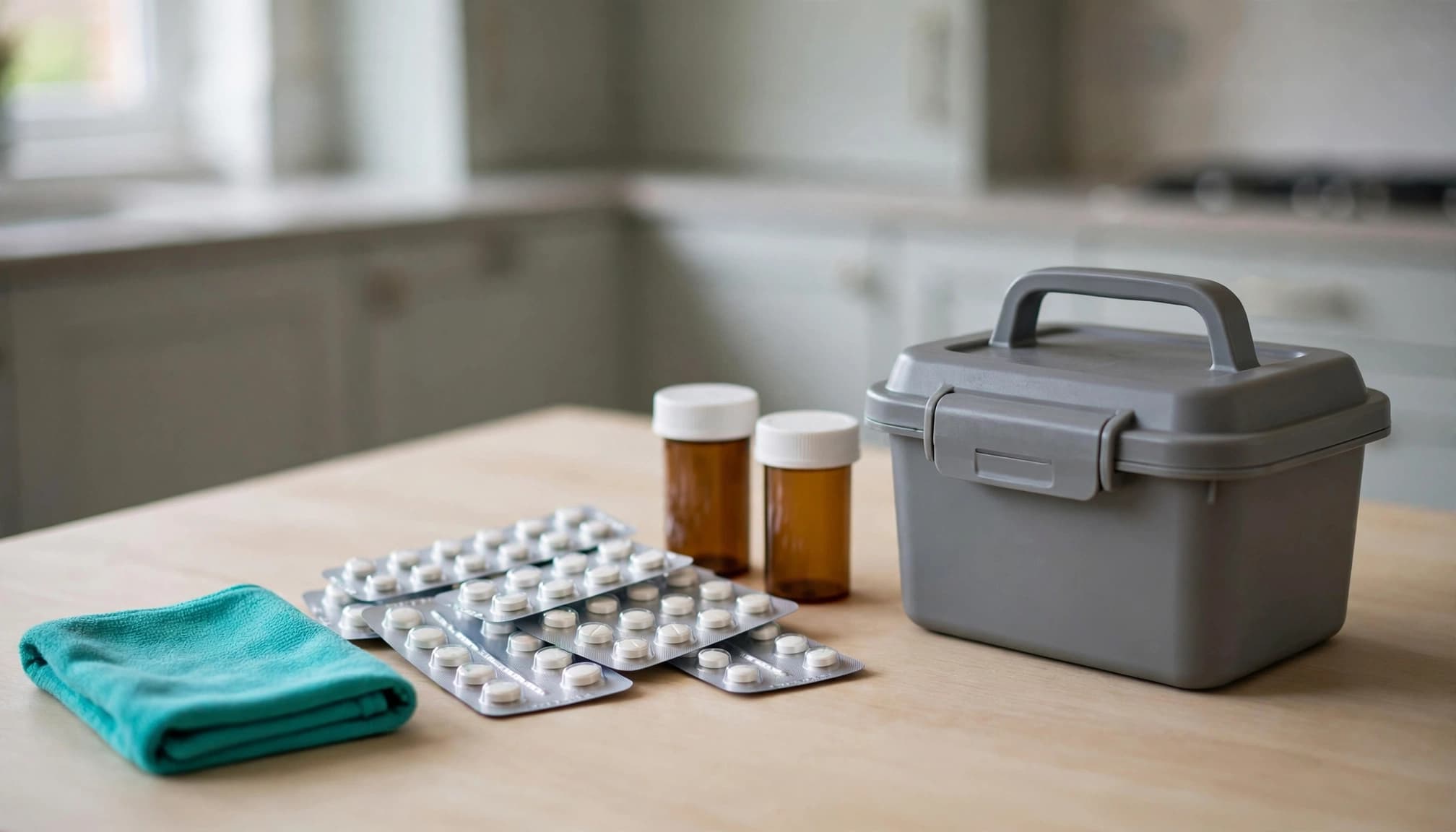
Keep tablets and capsules inside their blister packs. Leave bottled tablets in their bottles, and keep liquid medicines in their original containers with the lids secured.
Don’t combine loose tablets or pour different liquids together. Original packaging helps pharmacy staff identify what needs handling.
Keep medicines away from belongings intended for sale, donation or recycling. Partly filled blister packs don’t belong in an empty-packaging recycling scheme.
If containers are broken, leaking or unidentifiable, leave them undisturbed and ask a pharmacist about safe handling. Don’t open an unknown container to investigate it.
Store them securely until handover
Keep medicines awaiting disposal in a tamper-proof container within a locked cupboard, away from children, pets and visitors. NICE SC1 recommends secure storage in a tamper-proof container within a cupboard for care settings.
Keep the container separate from medicines someone still needs. If the property remains occupied, agree which current medicines must stay before removing anything.
Labels contain personal information. Keep labelled containers secure during sorting and transport, rather than leaving them amongst open clearance piles.
Following a death, medicines may need retaining for an investigation. Where that applies, follow the instructions given before arranging disposal.
2. Return household medicines to a pharmacy
Where to dispose of prescription medicines
In England, community pharmacies must accept unwanted household medicines under the NHS Essential service. You don’t need to return them to the pharmacy that originally supplied them.
Community Pharmacy England’s disposal guidance explains that the NHS arranges and pays for a waste contractor to collect pharmacy returns regularly. Householders aren’t charged for this pharmacy disposal service.
Most unwanted over-the-counter medicines can also be returned. The safest disposal of medication is to hand ordinary household medicines directly to pharmacy staff, rather than leave them outside or on an unattended counter.
The contractual arrangements described here apply to England. Services elsewhere in the UK can differ, particularly for unusual medicine types.
Why bins and drains aren’t suitable
Never flush tablets or pour liquid medicines into a toilet, sink or drain. Don’t put them in a wheelie bin, skip or general clearance load.
Medicines can cause harm if someone accesses them. Incorrect disposal can also release medicinal ingredients into the environment.
NHS advice on unwanted medicines directs householders to pharmacy disposal and warns against flushing.
This waste disposal route sends these returns to licensed treatment facilities, where active ingredients can be destroyed rather than released untreated.
3. Separate sharps and controlled drugs
Needles need a different collection route
Needles, syringes and lancets aren’t accepted through the standard pharmacy medicines-return service. Other clinical waste also needs separate arrangements, although some pharmacies provide additional commissioned services.
Don’t reach into bags or drawers where sharps are visible. Don’t recap needles or put them loose into a medicine-return bag.
Local authorities have a legal duty to arrange disposal of qualifying household clinical waste. Waste produced by visiting healthcare professionals may instead be their employer’s responsibility.
Contact the local authority to arrange the appropriate route. Collection arrangements depend on location and how the waste was generated.
Leave controlled drugs for professional handling
Morphine, oxycodone and some other prescribed medicines are controlled drugs. Keep them secure and return household supplies to a pharmacist.
Controlled drugs may need removing from their packaging and denaturing, which means making them unusable and irretrievable. Denaturing is professional disposal work. Don’t attempt to denature controlled drugs during a house clearance.
The Home Office recommends denaturing controlled drugs in Schedules 2, 3 and 4 (Part 1) before disposal. Its controlled-drug handling guidance also explains recording requirements.
Don’t crush tablets, cut patches or empty bottles to prepare them for destruction. Keep the original packaging intact for handover.
4. Agree the clearance handover
Finding medicines changes what needs separating, even where the rest of the property contains ordinary household belongings.
Tell the provider what you’ve found and where it is. Medicines, sharps and contaminated materials shouldn’t be assumed to fall within a standard clearance quote. Our guidance on items requiring separate handling explains these limits.
If a contractor will transport medicines waste, agree who will carry it and which authorised facility will receive it. The term “licensed waste carrier” is sometimes used informally. In England, check waste-carrier registration and any separate authorisations required for the specific waste and treatment. Registration alone isn’t enough.
Keeping records means retaining the written scope, receipt and any applicable disposal documents. A waste transfer note covers non-hazardous waste; hazardous waste may need different documentation. For a business clearance, check the applicable Hazardous Waste Regulations and record-keeping rules, which vary across the UK. Business transfer-note records are generally kept for two years, but private household clearances have different requirements.
If medicines or puncture-risk clinical waste are present, tell us about your property before the clearance is arranged. These items need a clear plan before loading starts.
Different rules apply to care settings
A private household return and a care-provider waste collection aren’t interchangeable. The setting determines the disposal route.
Care homes without nursing return unwanted medicines to their supplier, usually a community pharmacy or dispensing doctor. Nursing homes must use a licensed waste disposal company. A pharmacy can fulfil that role only where appropriately authorised.
CQC’s medicines-disposal guidance also prohibits disposal on site through the sewage system.
Remove stopped, expired or genuinely unwanted medicines from use promptly and arrange disposal without delay. This includes surplus left after a resident leaves. Medicines still needed by a resident moving elsewhere should accompany their care, rather than being discarded.
Disposal records should identify the date, medicine name and strength, quantity, and person it was prescribed for. They should include the signatures of the staff member and collector.
Statutory controlled-drug register requirements concern Schedule 2 medicines. Other disposal records can still be necessary, and household-return recording rules differ from those for a provider’s own stock.
Pharmacy and business requirements
These requirements cover professional waste handling. They aren’t instructions for a family clearing a home.
Secure storage and waste audits
Community Pharmacy England describes a temporary-storage exemption from environmental permitting, subject to conditions. Waste must be kept in secure containers, with no more than 50 cubic metres of solid waste stored.
Storage must last no longer than three months, and the waste’s flash point must be at least 21°C.
Since 1 July 2013, pharmacies have had to complete a pre-acceptance waste audit. It should cover every waste stream and be repeated every five years.
These conditions explain why a pharmacy needs suitable containers and available storage before accepting returns. They don’t make ordinary clearance vehicles or storage units suitable for medicines waste.
Registration and controlled-drug treatment
Older guidance refers to an exemption from hazardous-waste producer registration below 500 kg in any 12-month period. Since 1 April 2016, producers generating 500 kg or more in England have no longer needed to notify their premises.
This doesn’t remove business hazardous-waste duties. In England, the Hazardous Waste Regulations require businesses to classify, store, transport and document hazardous waste correctly. Rules differ elsewhere in the UK.
The Environment Agency permits denaturing controlled drugs returned from households under a regulatory position statement, subject to its conditions. Where applicable, businesses can register a T28 exemption for denaturing controlled drugs online.
Waste-carrier registration, a storage exemption and authority to treat controlled drugs are separate matters. None gives general permission to handle every medicine or clinical waste stream.
Frequently asked questions
Do Boots pharmacies take old medicines?
Boots pharmacies providing NHS community pharmacy services in England accept unwanted household medicines under the same Essential service. Return medicines to pharmacy staff, not an empty-blister-pack recycling point.
Sharps and other clinical waste remain outside the standard medicines-return service.
Can unused prescription medicines go to charity?
Don’t place medicines in charity-shop donations or pass them to another person, even if unopened and within date. The right route for medicines found in a property is safe disposal.
NHS Highland’s medicines-return guidance explains that returned medicines aren’t reused for other patients. A sealed box doesn’t establish how it has been stored.
Can a pharmacy refuse a return?
In England, accepting household medicines is an NHS Essential service obligation. However, a pharmacy may temporarily lack safe capacity, such as when its waste containers are full.
Other excluded waste, including commercial stock, isn’t covered by that obligation. For a large quantity, leaking containers or an unusual medicine type, ask the pharmacist to arrange a safe handover rather than arriving with an unsecured load.
Keep medicines separate until safe handover
You don’t need to solve every part of a clearance at once. Keep medicines secure, leave their packaging intact and arrange a pharmacy return for ordinary household supplies.
Puncture-risk clinical waste, care-provider waste and specialist medicines need their own arrangements. A clear handover keeps these items out of general waste and gives everyone involved an agreed next step.
