 Skip to content


If you find suspected asbestos during a property clearance, stop work in that area, keep people away and seek competent professional advice. Don’t touch, disturb, sweep, vacuum or dispose of it.
Finding suspect material doesn’t mean the whole property needs stripping out. Safe asbestos property clearance starts with assessment, so everyone understands what can stay, what needs attention and when work can resume.
You don’t need to identify the material yourself. The first step is to leave it undisturbed.
Key takeaways
- Suspected asbestos needs professional assessment. Appearance alone can’t confirm it.
- Confirmed asbestos in good condition can often remain in place if it won’t be disturbed.
- Specialist assessment, removal, disposal and clearance testing are separate from ordinary property clearance.
What to do immediately
Stop work and keep the area undisturbed
Don’t move furniture, boxes or rubbish through the affected area. Keep residents, visitors, workers and pets away. Tell the person responsible for the property and anyone arranging clearance or repairs.
Don’t break off a sample, bag loose pieces or carry material outside. Photographs may help explain the situation, but don’t enter an unsafe area to take them.
Our guidance on restricted property clearance items explains why suspected asbestos needs separate arrangements rather than ordinary household disposal.
If material has already been disturbed
Stop immediately and leave the affected area. Don’t try to make it look clean before somebody attends.
Sweeping, dry brushing and domestic vacuum cleaners can spread fibres. A household vacuum isn’t suitable for asbestos dust.
Tell the asbestos professional what happened, which rooms were involved and whether belongings or equipment were moved elsewhere. They can assess possible contamination and explain what needs to happen before access resumes.
Establish whether asbestos is present
Older materials need assessment
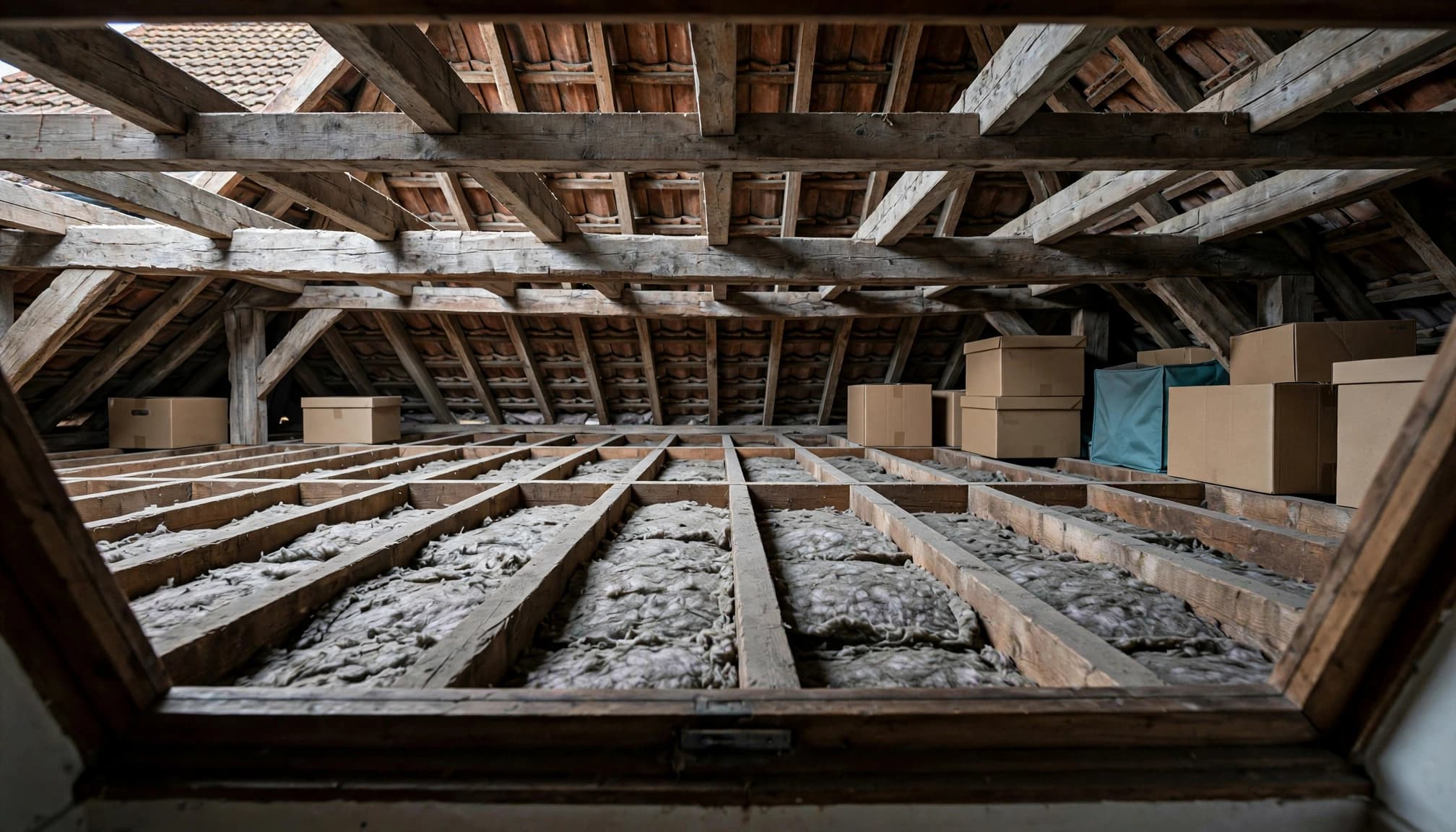
Buildings constructed or refurbished before 2000 may contain asbestos. Blue asbestos, crocidolite, and brown asbestos, amosite, were banned in the UK in 1985. White asbestos, chrysotile, was banned as a construction material in 1999.
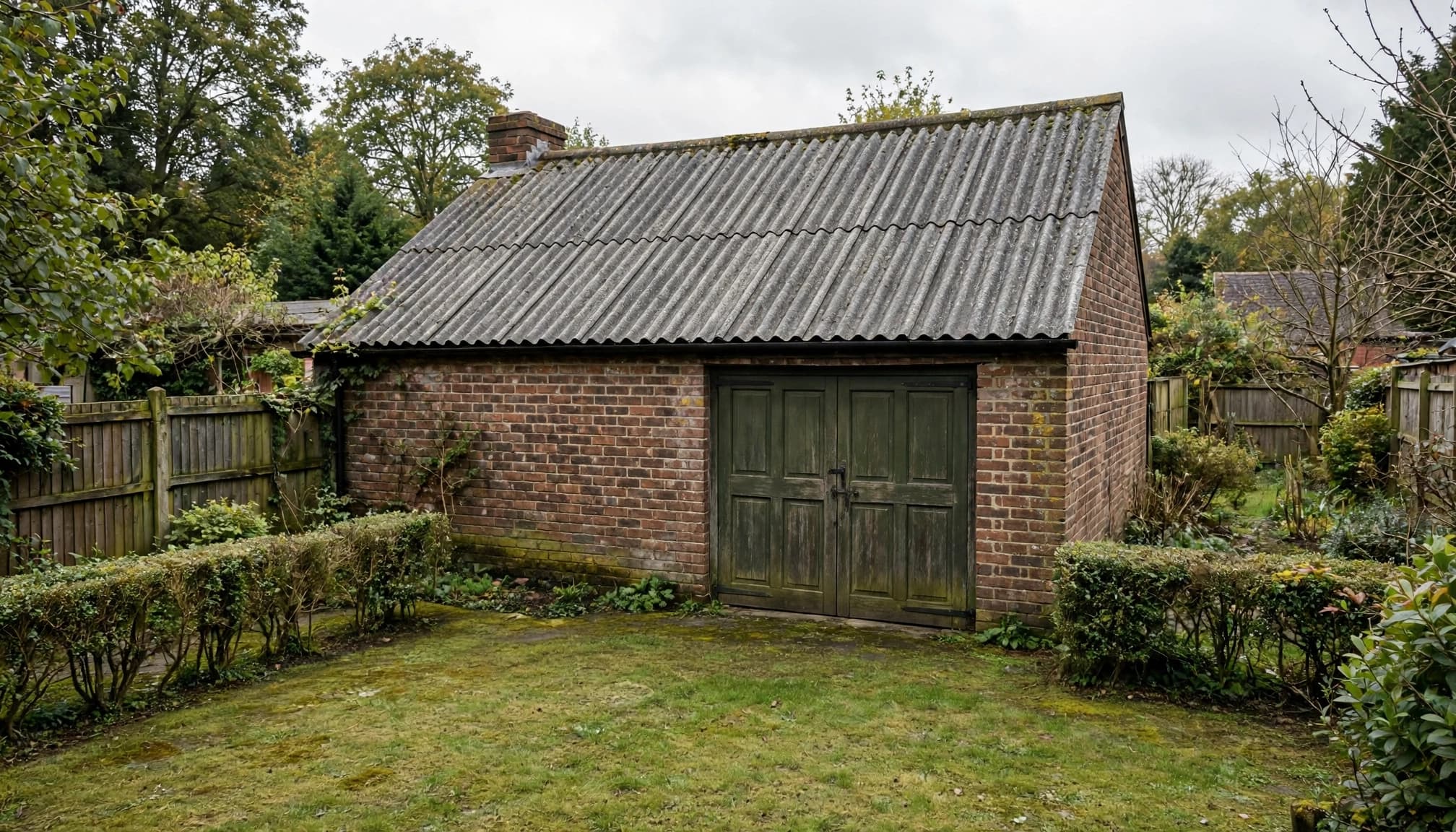
Possible locations include garage roofing, floor tiles, textured coatings, insulation boards and pipe lagging.
Asbestos cement commonly contains around 10% to 15% asbestos. Some insulating boards contain up to 40%, and sprayed coatings up to 85%. These figures aren’t identification tools. Laboratory analysis of a professionally collected sample confirms whether asbestos is present.
Arrange the right survey
Arrange an asbestos survey with a suitably competent professional. A management survey identifies materials that could be disturbed during normal occupation and maintenance. Refurbishment or demolition affecting the building fabric needs a survey suited to that work.
Tell the surveyor about inaccessible rooms, lofts and areas hidden by belongings. An uninspected area hasn’t been shown to be asbestos-free.
BOHS P402 is a relevant surveying qualification. It isn’t an asbestos removal licence, and it isn’t a qualification every clearance worker must hold.
Does confirmed asbestos need removing?
When leaving it in place is appropriate
Asbestos presents a health risk when fibres become airborne and are breathed in. Material in good condition can often stay if it remains undisturbed and its condition is monitored.
Encapsulation may be suitable in some cases. This means professionally sealing or protecting the material to reduce fibre release.
It doesn’t remove the asbestos. Its location still needs recording, and future workers need to know it’s there. A planned refurbishment may make removal more appropriate than continued management.
When specialist removal is needed
Asbestos removal isn’t automatically required. The decision depends on the material’s condition and whether planned work will disturb it.
Under the Control of Asbestos Regulations 2012 in Great Britain, work involving insulation, pipe lagging, sprayed coatings and much asbestos insulating board commonly requires a licensed contractor holding an HSE licence.
Some lower-risk work, including certain asbestos cement tasks, can be non-licensed. HSE’s non-licensed asbestos work guidance explains that assessment, training and suitable controls still apply.
Non-licensed doesn’t mean suitable for an untrained homeowner or ordinary clearance team.
Agree removal and waste arrangements separately
Asbestos removal is specialist work, separate from ordinary property clearance.
For licensable work, the contractor must hold a current HSE licence. HSE’s licensable asbestos work guidance sets out the higher-risk work covered.
The written scope should identify the material, affected areas, controls and waste arrangements. It should state whether clearance testing is required and, where applicable, who will appoint the independent analyst and provide the clearance certificate.
Depending on the job, professional controls may include an enclosure, controlled wetting, specialist Class H vacuum equipment and decontamination arrangements. These are specialist working methods, not instructions for household cleaning.
Asbestos waste must never go into household bins or general skips. The contractor needs an appropriately registered waste carrier, a facility permitted to accept asbestos and the relevant consignment documentation.
In England, waste-carrier registration is separate from an HSE asbestos licence. A so-called “Hazardous Waste Carriers Licence” doesn’t replace either requirement.
Keep the consignment note. It records the waste movement, but doesn’t prove the building is safe to reoccupy.
How asbestos property clearance is verified
Where four-stage clearance is required, the certificate of reoccupation must come from an independent analyst working through a UKAS-accredited organisation, not the removal contractor. The resulting clearance certificate is issued once the applicable process is complete.
HSE’s HSG248 analysts’ guide sets out the process:
- A preliminary check examines the site conditions and whether the agreed removal work is complete.
- A thorough visual inspection looks for remaining asbestos debris and dust inside the enclosure.
- Clearance air testing assesses airborne fibres.
- A final assessment takes place after the enclosure is dismantled.
The UK clearance indicator is 0.01 fibres per millilitre, measured using phase contrast microscopy. Results must satisfy the clearance requirements. This isn’t a guarantee of zero fibres.
Not every asbestos job needs this full procedure. The evidence required depends on the material and work undertaken.
Keep the survey, laboratory results, agreed scope, completion records, certificate of reoccupation, applicable clearance certificate and waste consignment note together. Update any asbestos register and management plan to show what remains.
A certificate covers the assessed work area. It doesn’t declare every uninspected part of the property asbestos-free.
What might asbestos assessment and removal cost?
There isn’t one reliable national price. Material, condition, access, quantity, enclosure requirements, air testing and location all affect the cost.
Low advertised figures need careful scope comparison. Prices such as £80 for a residential survey, £200 for a “removal survey”, £1,250 for a garage roof or £50 per square metre for tiles or panels aren’t standard tariffs.
Published estimates also vary considerably. MyJobQuote gives these indicative figures:
| Work | Published estimate |
|---|---|
| Asbestos survey | Around £325 |
| Encapsulation | Around £30 per m² |
| Removal | Around £60 per m² |
| Garage-roof survey and removal example, 20 m² | Around £1,200 |
These are budgeting figures, not interchangeable quotes.
Using those square-metre rates, 20 m² would calculate to £600 for encapsulation or £1,200 for removal. That comparison only helps where both options are technically suitable. It doesn’t establish the full price for a particular material or property.
The written quote should state whether VAT, testing, waste disposal, clearance testing and replacement roofing or finishes are included. Specialist asbestos work should be priced separately from ordinary clearance.
Landlords, sellers and property handovers
Rental properties need a recorded response
In England, asbestos alone doesn’t automatically constitute disrepair. Damaged asbestos affecting the structure, exterior or relevant installations can engage duties under section 11 of the Landlord and Tenant Act 1985.
The Housing Health and Safety Rating System is the framework councils use to assess 29 hazards, including asbestos and manufactured mineral fibres. If a council identifies a category 1 hazard under the Housing Health and Safety Rating System, it must take enforcement action. Shelter’s asbestos housing guidance explains these distinctions.
Record the report, assessment, action taken and information given to tenants. The Housing Health and Safety Rating System applies in England, and housing law differs across the UK.
Sales and future work need clear records
Tell your conveyancer about known asbestos and answer property enquiries accurately. Provide survey reports, removal records, any relevant clearance certificate and, where the duty to manage applies, the management plan.
A buyer finding previously unknown asbestos doesn’t, by itself, mean the seller misrepresented the property.
The Regulation 4 duty to manage generally covers non-domestic premises and shared parts of residential buildings, not an ordinary owner-occupied home. Contractors’ exposure-control duties still apply when working inside homes.
Before clearance restarts, agree which areas are available, which belongings need specialist assessment and what remains excluded. Our guidance on next steps after property clearance helps separate that handover from later inspections and repairs.
Frequently asked questions
Is loft insulation likely to contain asbestos?
Much UK loft insulation is mineral wool, but appearance isn’t enough to identify an unknown material. Asbestos may also be present around pipes, tanks, boards or other older components.
Don’t lift insulation or move stored belongings to investigate. Explain the location to a competent surveyor and leave sampling to someone suitably trained.
What is secondary asbestos exposure?
Secondary exposure happens when fibres are carried away on clothing, tools or belongings and another person breathes them in.
Don’t shake dusty clothing or put potentially contaminated items into ordinary laundry. Seek professional decontamination advice. If you’re concerned about a possible exposure, tell your GP what happened and when. Exposure doesn’t automatically mean illness, and immediate scans generally can’t establish whether fibres were inhaled.
A clear next step before clearance continues
Suspected asbestos needs a pause and a competent assessment. Confirmed asbestos needs an agreed decision based on its condition and the work planned.
Keep specialist work and ordinary clearance clearly separated. Retain the records explaining what was assessed, what was done and what remains.
You can tell us about your property with what you already know. We’ll explain what clearance work we can safely undertake and where specialist support is needed.
