 Skip to content


A property can become difficult to face long before it becomes difficult to clear. A professional house clearance gives you a clear plan for dealing with furniture, belongings, waste and rooms that need attention.
You don’t need to empty cupboards, sort every drawer or make every decision before asking for help. The right house clearance services will assess the property, sort what needs attention, remove agreed belongings and handle waste responsibly.
Key Takeaways
- A professional house clearance should begin with an assessment of the property, access and your priorities, followed by a written quote that clearly sets out what stays, what goes and what is included.
- Belongings should be sorted carefully, with clear instructions for sentimental items, documents, valuables and anything that needs a decision before removal.
- Check that the provider is insured, uses a licensed waste carrier and can provide a Waste Transfer Note for non-hazardous waste.
- House clearance costs depend on volume, access, sorting, heavy items, disposal and any cleaning or specialist work required. Asbestos, chemicals and biohazards need separate arrangements.
- A clear handover, including agreed completion details and photographs where needed, helps make the property manageable without requiring you to attend every stage.
The first stage of a house clearance
Every property is different. A clearance after a bereavement needs a different approach to a landlord’s end of tenancy property or a heavily cluttered home.
Start with an assessment
The first conversation is about the property and what you need the house clearance process to achieve. You may be asked for photographs or video, or a visit may be arranged where the situation needs to be seen in person.
The company should ask about the size of the property, which rooms are included, the amount of contents, access, parking and the date you need the work done. Tell them about lofts, garages, outbuildings and any rooms that are difficult to enter.
Once the property, access and scope have been reviewed, you can request a free quote. It’s also the time to mention anything that may need special care. This could include documents, photographs, jewellery, keys, medication, family papers or an item you hope to find.
Agree the scope before work begins
A written quote should set out what is included. That might be a full house clearance, selected rooms, furniture removal, rubbish removal, garden clearance or cleaning after the property has been cleared.
It should also make clear what stays, what goes and what needs a decision. For non-hazardous waste, confirm whether the company will provide a waste transfer note. If several family members, executors or property professionals are involved, one person should be named to give final instructions.
Access arrangements matter too. A team may need keys, parking permissions, lift access or confirmation that neighbours have been informed where work could affect a shared entrance.
If you’re dealing with a property in Doncaster, Sheffield, Rotherham, Barnsley or nearby, you can tell us about your property before you have everything organised.
What happens on clearance day
Once the plan is agreed, the team works through the included areas methodically. They should follow the instructions already given, rather than making assumptions about unwanted items.
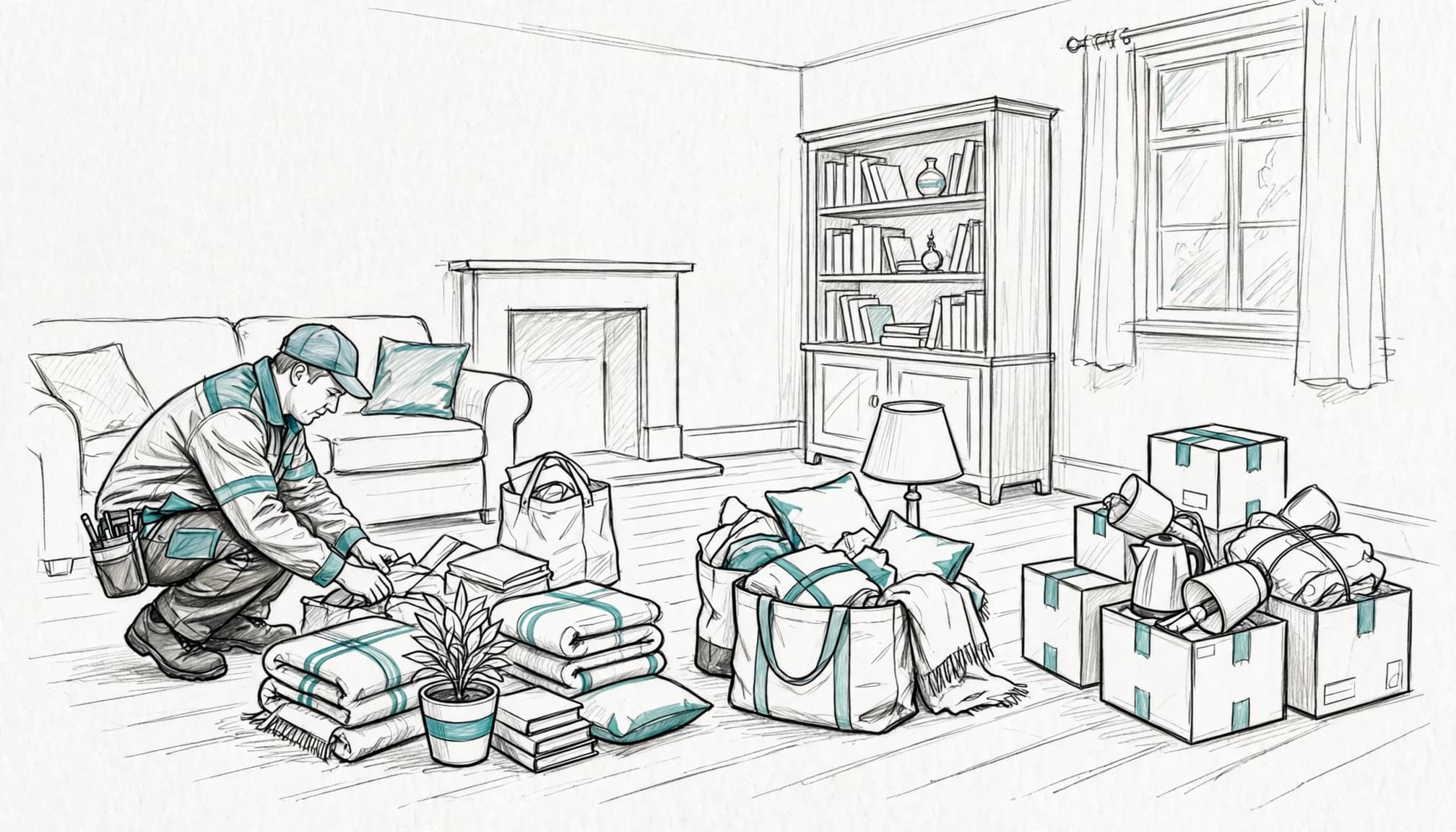
Belongings are sorted before they are removed
A careful clearance often separates contents into three simple groups: keep, remove and needs a decision. This is particularly important during a bereavement house clearance, where everyday items can sit alongside paperwork and belongings with real personal value.
Give the team clear instructions before they start. Say if they should look out for passport documents, photographs, personal letters, spare keys, military medals or jewellery.
No company can promise to find every item in a heavily cluttered property. Still, knowing what matters changes how the work is approached. Items that have not been approved for removal should not simply be treated as waste.
Furniture, appliances and waste are taken out safely
The team will remove agreed furniture, household contents and accumulated waste. This may include appliance removal, fridge removal, sofa removal and mattress disposal, where these are within the agreed scope and can be handled safely.
Large wardrobes, beds or other items may need dismantling to get them out without damaging the property or blocking access.
During belongings removal, the team should take reasonable care around walls, floors, stairways and shared areas. If an unexpected issue changes the job, such as a room containing far more material than expected, the work should pause for a discussion before extra charges or additional tasks are agreed.
You don’t always need to attend in person. Once instructions, access and authority are clear, a clearance can often be completed while you are elsewhere. Remote clients may ask for completion photographs as part of the agreed handover.
Where the contents go after removal
House clearance does not mean everything goes to one destination. Belongings may be retained, reused, donated to a local charity, recycled or disposed of, depending on their condition, ownership and the provider’s arrangements.
Valuable and sentimental items need clear instructions
A clearance team can sort and set aside items where that forms part of the agreed work. It is not their role to decide who owns a valuable item or whether a family heirloom should be sold, donated or kept.
Before probate clearance begins, executors and families should remove anything already identified as important. Then provide a short written list of items the team should look out for.
Useful instructions are concrete. “Keep all photo albums in the front bedroom” is clearer than “save anything sentimental”. Tell the company who can make a decision if an item cannot be placed in a clear category.
A property can be cleared room by room. You don’t have to decide the future of every belonging on the same day.
Standard clearance is not specialist hazardous work
A normal property clearance may include ordinary household goods, furniture and non-hazardous waste. It does not automatically cover asbestos, unknown chemicals, sharps, bodily fluids, pest-contaminated areas or biohazard cleanup.
Tell the provider what you know before work begins. They should assess the risk and explain what they can safely handle. Where another appropriately qualified service is needed, that should be stated plainly.
The same applies to badly neglected properties. Heavy clutter may hide damaged floors, mould, animal waste or restricted access. The job may need structured sorting, specialist cleaning or a phased plan before the property can move towards repair, sale or re-letting.
Waste paperwork and responsible disposal
Once material leaves the property, it still needs to be handled properly. A waste transfer note helps record its movement, while legitimate waste disposal routes remain the provider’s responsibility.
Paying someone to take material away does not remove the need to use a legitimate operator. Sorting and recycling can make the process more environmentally friendly, where suitable facilities are available.
Ask for a Waste Transfer Note
A waste transfer note records the transfer of non-hazardous waste between parties. It helps show what was collected, who took it and when the transfer happened.
In England and Wales, the Waste Duty of Care Code of Practice sets out responsibilities for people who produce, carry, keep, treat or dispose of controlled waste.
Ask your provider what paperwork they will supply after collection, including a waste transfer note. Industry guidance on retaining Waste Transfer Notes confirms that a waste transfer note should be kept for at least two years.
Suitable separated materials may be sent to an authorised facility, such as a commercial recycling centre. However, don’t accept claims of zero waste to landfill without clear evidence.
Keep the document with your property records, particularly if you are an executor, landlord or letting agent. It is a simple record that the material left the property through an identified route.
Check the waste carrier, not just the van
A professional appearance does not prove that a business can lawfully carry waste. Check that the company uses a licensed waste carrier before agreeing to the collection.
In England, businesses that transport, buy, sell or broker waste must register with the Environment Agency.
You can use the public waste carrier register to check the business name or registration details. GOV.UK also explains waste carrier registration requirements.
Be cautious if a trader will only take cash, refuses to provide business details, offers an unusually vague price or cannot explain where material will go. If waste is fly-tipped after collection, the person who arranged removal may still face difficult questions.
What affects the house clearance cost?
There is no reliable single price for a standard property. The house clearance cost depends on the contents, the work involved and the practical conditions on site.
What a quote should take into account
Volume is only one part of the job. A small flat on an upper floor with no lift may take more labour than a larger property with easy access.
Sorting requirements, heavy furniture, long carrying distances, parking restrictions, waste type and cleaning can all affect the price. A probate clearance may also take longer when items need to be set aside for decisions.
Ask whether the agreed scope is offered at a fixed price. Check whether the quote covers labour, loading, transport, disposal and VAT where applicable. Unexpected conditions or additional work may change the final price.
Check whether cleaning, garden work, dismantling and completion photographs are included or priced separately. This helps you compare quotes on a like-for-like basis.
Is a skip cheaper than a clearance service?
A skip can work well when you’ve already sorted the property, have space for a permit and can load it safely yourself. It may be less suitable where there are stairs, unknown contents, limited parking or belongings that need care.
A professional house clearance includes the physical work of sorting, carrying and removing agreed items. Tasks such as sofa removal can be difficult to complete safely without the right equipment and team.
Compare the full cost, including labour, transport, disposal and cleaning, rather than assuming one option is always cheaper. A lower quote may leave you with extra work, leftover rooms, paperwork or disposal charges afterwards.
Choosing a company you can trust
The right provider should make the situation feel clearer, not more confusing. When comparing house clearance services, check who is doing the work, what they are removing and what happens afterwards.
Questions worth asking before you book
Ask whether they are fully insured for the agreed clearance work, registered to carry waste and able to provide a Waste Transfer Note. Confirm when and how the waste transfer note will be supplied. Ask how they deal with items that are not clearly approved for removal.
Find out whether the quote is fixed for the agreed scope and what happens if the job changes. If access is difficult, ask how the team will manage stairs, parking, narrow corridors and shared entrances.
For a property that needs clearance and cleaning, ask whether both can be included under one agreed plan. One point of contact can make handover easier when the property is moving towards inspection, repairs or sale.
Warning signs to take seriously
Avoid anyone who pressures you to decide immediately or refuses to put the scope in writing. You shouldn’t be told that every item must be removed on the spot.
Be wary of promises that everything will be recycled or donated without any explanation of how that will happen. Responsible disposal means being honest about what can be reused and what cannot.
A good provider will also be clear about limits. They won’t pretend that asbestos, chemicals or biohazard cleanup are ordinary clearance work. Clear answers now prevent problems later.
Frequently asked questions
Can I arrange an urgent clearance?
Sometimes, yes. Same day house clearance availability depends on the job size, access, staff availability and safety considerations. Send photographs or video early, as this helps a company assess whether the work can be completed safely within your timescale.
What happens during probate or bereavement clearance?
The priority is clear instructions and a manageable pace. The executor or family representative confirms what has been authorised for removal, what must stay and anything the team should look out for. Not every decision needs to be made at once.
Can a company clear my garden, garage or loft?
Often, garden clearance, garage clearance and loft clearance can be included where agreed. Mention these areas during the assessment, especially if access is limited or there are heavy items, fridge removal, chemicals or damaged structures that may need separate arrangements.
Does end-of-tenancy clearance include cleaning?
It can, but it is not automatic. Agree whether the work is clearance only or whether cleaning is included afterwards. A clear handover should show what has been completed and what still needs attention.
A clear plan makes the property manageable
A well-managed clearance should begin with understanding the property, not rushing to fill a van. The important decisions are what stays, what can go and what needs more time.
With an agreed scope, responsible waste handling and a clear handover, an overwhelming property becomes a set of practical next steps. You do not need to face the whole job alone.
